
We use cookies to personalise content and ads, to provide social media features and to analyse our traffic. We also share information about your use of our site with our social media, advertising and analytics partners who may combine it with other information that you’ve provided to them or that they’ve collected from other web pages that is not governed by us.
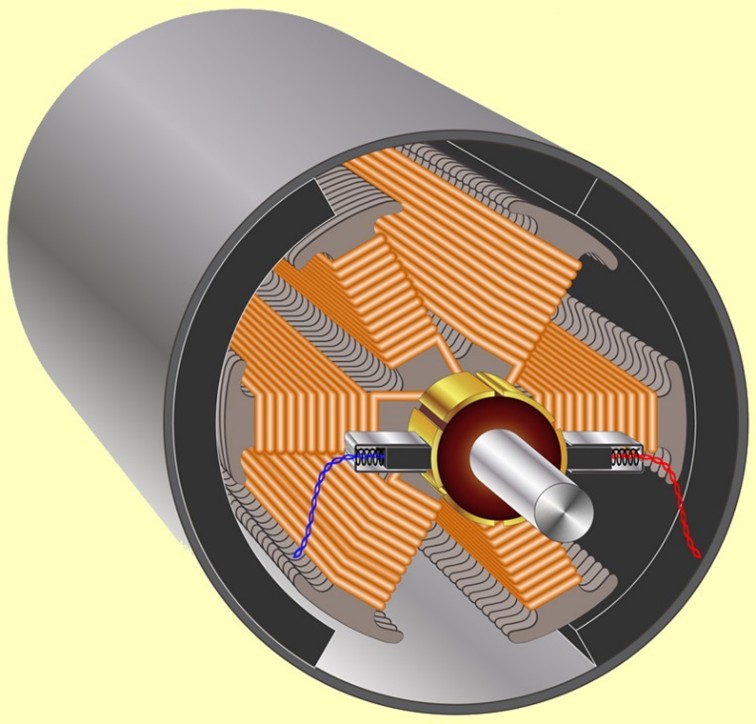
DC Motors
DC Motors
In this training session, we will explore DC motors. This training module is ideal for both new and experienced electricians and technicians who install, maintain, repair, or troubleshoot rotating machines.
Learning Objectives:
- Using the right-hand rule for motors, determine the direction of the magnetic field, direction of current flow, or force on a conductor.
- State the function of torque in a direct current motor and how it is developed.
- Describe how Counterelectromotive Force (CEMF) is developed in a DC motor.
- Describe the relationship between field current and magnetic field size in a DC motor.
- State the function of the CEMF that is developed in a DC motor.
- Describe how the speed of a DC motor is adjusted.
- Describe the relationship between armature current and torque produced in a DC motor.
- Describe the differences in construction between a shunt-wound and a series-wound DC motor with respect to the relationship between the field and the armature windings.
- Describe the construction of a compounded DC motor.
- Describe torque-vs-speed characteristics for a shunt-wound and a series-wound DC motor.
- Explain why starting resistors are necessary for large DC motors.
- List the four nameplate ratings for a DC motor.
Prerequisites:
Participants should have basic knowledge of basic algebra, electrical theory, magnetism, and magnetic induction.
TRAINING TYPE
E-LEARNING